
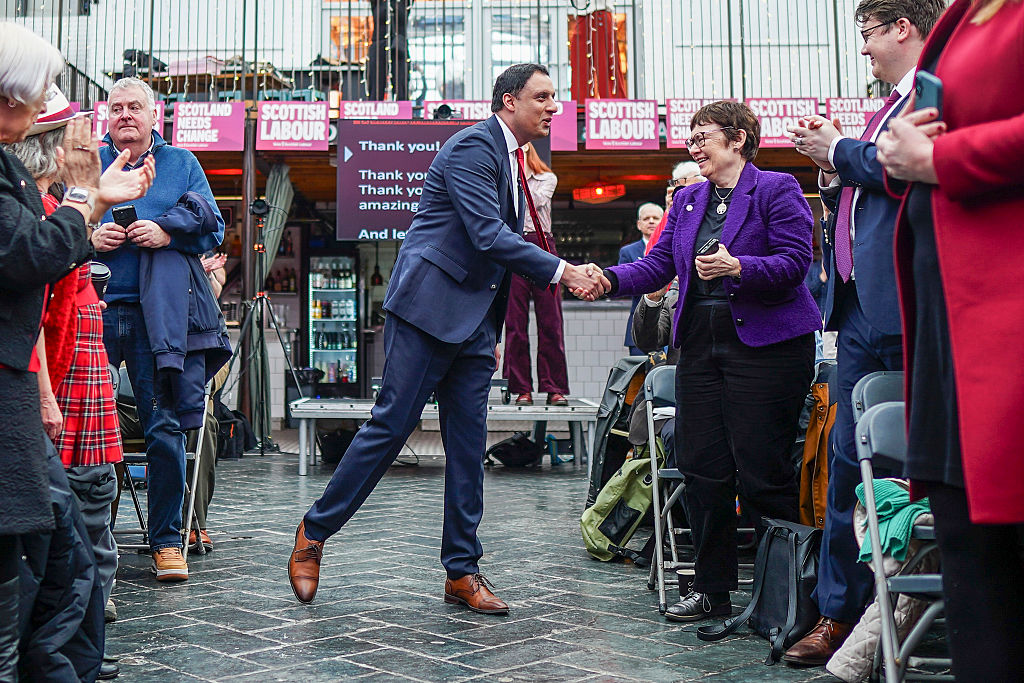
Anas Sarwar’s new party political broadcast is, as these things go, a banger. The film follows him around the campaign trail, with scenic shots of Scotland’s cities, its islands and its countryside. It has kids and pets and pubs, and plenty of saltires, all backed by a rousing song: “There’s a place I know, and magic where the flowers grow, and beauty where the rivers flow, over hills and country roads, Scotland is a place called home.”
The intention is to capture Sarwar’s personality in two-and-a-half minutes: warm, optimistic, passionately Scottish, and full of energy; ready for government, ready for change. It does that rather well. In truth, it feels like something the SNP might have put out during the independence referendum. One must always be wary of politicians and what they’ll tell you during election campaigns. To get through the 24/7 grind, many become something less than human: robotically certain of their own success, Panglossian about their party’s prospects (regardless of what the polls say), grimly on-message until the votes are counted and reality intervenes.
To be fair, if you’re a Labour candidate in this Holyrood election, this is probably what it takes to get out of bed in the morning. A party that seemed a shoo-in until shortly after the last general election is in deep trouble with just a month to go. Having started the campaign around 14 points behind the SNP, the most recent polls suggest the gap may have grown beyond 20 per cent. If the initial figure can be blamed largely on the impact of a deeply unpopular Westminster government and Prime Minister, the increase over recent weeks is harder to fathom.
A bit like a football manager in the early days of a wholesale rebuild, Labour’s mantra is to think about “the process, not the result”. There is a concentration on the party’s “significant operational assets”. It has more money than the SNP, and is “flooding the zone” on social media. There is a belief that Sarwar is a more energetic and charismatic leader than John Swinney, that Labour has a stronger team in its HQ, and that it has more activists out on the doorstep. The troubling poll numbers have created a sense of defiance and determination rather than desolation and pessimism.

Despite what the party’s leaders hold to be a strong first ten days or so of the campaign, there is little evidence yet that the numbers are likely to shift in any profound fashion. Hopes are being pinned on the fact that around four in ten voters are yet to make up their minds. Every effort is being made to stick the SNP’s weak record in power to the governing party, which is doing its best to talk about anything but that. Swinney is more inclined to raise the faults of Keir Starmer, and to point to a golden future under independence. The electorate, understandably, is also distracted by the current occupant of the White House and his threats to wipe out civilisations – it is difficult to change minds if people aren’t paying attention.
We have, predictably, reached the retail stage of the campaign. Labour will launch its manifesto on Monday, which will be framed around “getting the basics right” and “fixing the SNP’s mess”. There is a sense that the public is so beaten down by the harshness of the cost of living crisis, and by SNP failure (and Tory-Labour failure in Westminster), that they are unconvinced big change is any longer possible: that their ambitions have been reduced to “do no harm”. Sarwar is promising a £100 million package to address living costs. A further £350 million would be deployed to fix the estimated 4.8 million potholes blighting Scotland’s roads. There is a pledge of 125,000 new homes, 9,000 apprenticeships, higher standards in schools and an NHS that is there “when you need it”. All of this is mapped on to what research tells Labour are voters’ major concerns. It’s basic stuff, not a radical new direction.
There is hope, too, that Reform have peaked. Recent polls have suggested that its support has fallen back slightly after a bumpy start to its Holyrood campaign. It has lost a number of candidates and, as one Labour insider put it to me, its leader Malcolm Offord is “having a ‘mare”. If the insurgent party has lost momentum, then there is a chance that Labour voters who were considering switching will instead return to the fold in time for May 7.
Belief, optimism, hope, determination… these things can only take you so far. With four weeks to go, and a substantial SNP lead seemingly baked in, there is vanishingly little time left for Labour to turn things around. Sarwar’s broadcast ends with him strolling down a Glasgow street as a crowd of people come out to walk behind him – think the famous Rocky scene, but at walking pace. Will enough Scots follow him on May 7? Frankly, it’s not looking great.
[Further reading: Goodbye to a dishonest and dismal Holyrood parliament]
Content from our partners


Related
Join the debate
Subscribe here to comment